
Deterministic Reasoning
No black-box inference in clinical outputs. Explicit logic you can trace.
No black-box inference in clinical outputs. Explicit logic you can trace.
Lock reasoning logic during evaluation for reproducibility and auditability.
The system doesn’t learn from or adapt based on individual patient information.
No automated clinical actions or risk escalation. Insight informs; clinicians act.
Every output can be traced back to specific evidence and logic.
Clinicians review, challenge, and decide. Always.
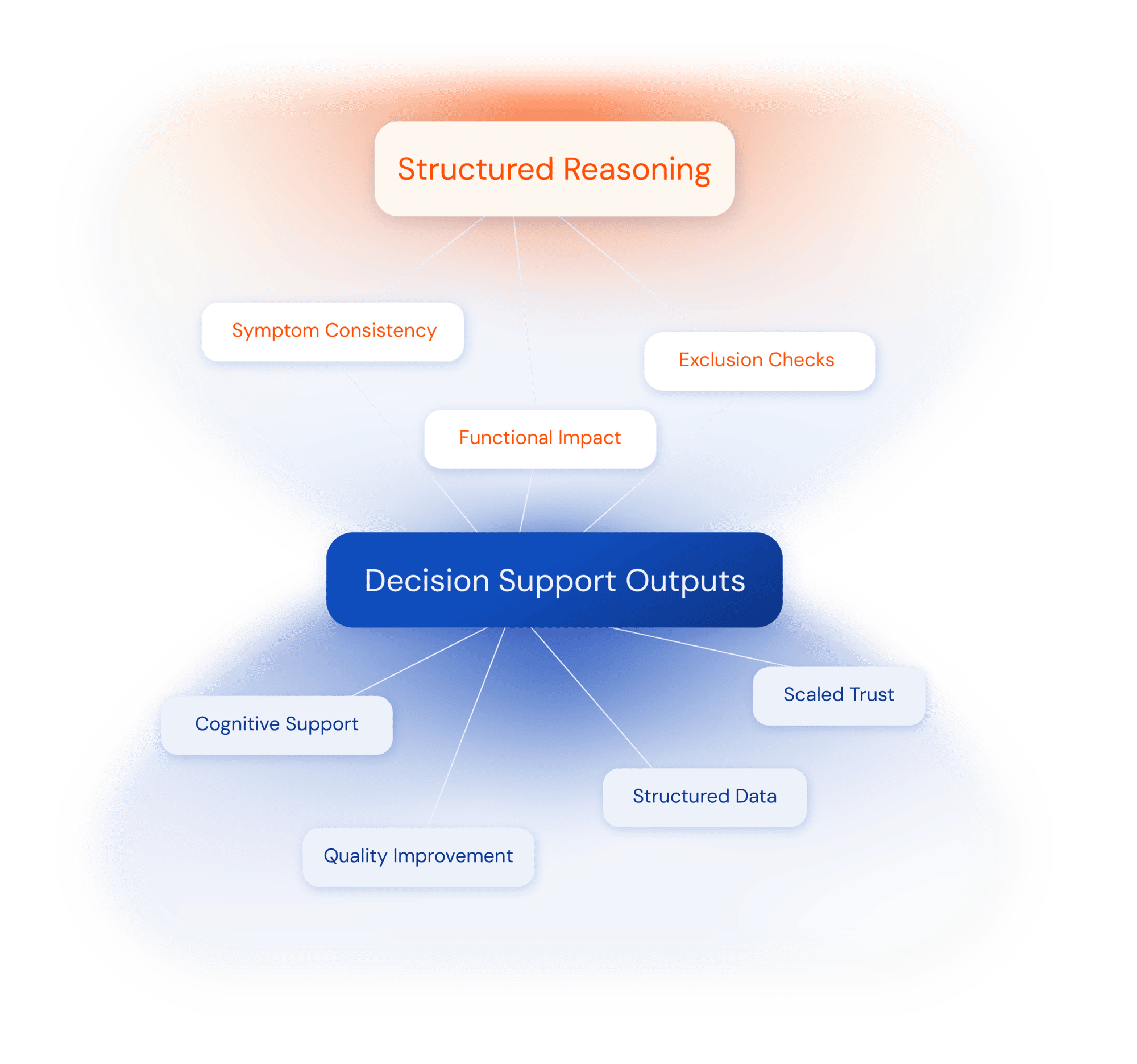
When clinical reasoning becomes explicit and inspectable:
Clinicians get cognitive support without loss of authority
Organizations can govern AI they actually understand
Researchers can study reasoning itself—not just outcomes
Quality improvement becomes grounded in logic, not inference
The data generated becomes structured, studiable, and valuable
This is how trust scales in mental health. Not by automating decisions—by making reasoning visible enough to govern.
Neoptio Insight™’s architecture is built not just for today’s governance requirements, but for tomorrow’s regulatory landscape.
We are intentionally building:
Clinical Decision Support (CDS) is where we start. It is not where we stop.
Clinician-governed reasoning support. Deployable under current frameworks. Building evidence and relationships.
Structured data from real-world deployment. Validation studies. Clinical outcome tracking.
Architecture designed to support regulatory pathways as evidence accumulates.
Reasoning infrastructure you can actually deploy.
Clinical reasoning support that your medical advisory committees, privacy offices, and clinical leadership can actually approve.
Defensible assessment at scale.
Auditable reasoning paths that support defensible decisions in high-volume, high-scrutiny environments.
The reasoning layer you don’t have to build.
Comprehensive clinical reasoning infrastructure you can integrate—without building the clinical logic yourself.
Structured clinical reasoning data at scale.
Sharper patient stratification, cleaner cohort identification, and visibility into clinical formulations.
Does structured reasoning support improve clarity and completeness of assessment?
Does the system support coherent reasoning across reassessment and over time?
Does structured reasoning reduce clinician cognitive burden during assessment?
Is the system understandable and acceptable to clinicians in practice?